How To Keep Children Entertained On Long Haul Flights
A practical step-by-step guide to how to keep children entertained on long haul flights, including preparation, instructions, common issues, tips, and next steps.
How To Keep Children Entertained On Long Haul Flights
Entertaining children on long haul flights requires preparation, flexibility, and a toolkit of activities that engage different ages and interests. This guide covers essential pre-flight steps, in-flight strategies, problem-solving tips, and checklists to help both you and your child arrive calm and refreshed.
Fast Answer
- Pack a variety of lightweight, mess-free activities in a carry-on bag, including coloring books, sticker sets, and small toys, and introduce them gradually during the flight.
- Plan to break the flight into smaller time chunks, alternating between screen time, quiet games, snacks, and physical movement in the aisle, so your child stays engaged without getting bored or restless.
Before You Start
- Choose flights that align with your child's sleep schedule when possible, and book seats with extra legroom or near the lavatory to make moving around easier.
- Pack a separate kid-sized backpack with their favorite snacks, a refillable water bottle, and activities, but weigh it so it's easy for them to carry.
- Download or bring a variety of age-appropriate games, movies, and audiobooks that don't need internet, and test them on your device before the trip.
- Bring a few small, surprise gifts or new toys that are never seen before, and wrap them in tissue paper so they become exciting reveals during the flight.
Step-by-Step Instructions
Pack a Surprise Activity Bag
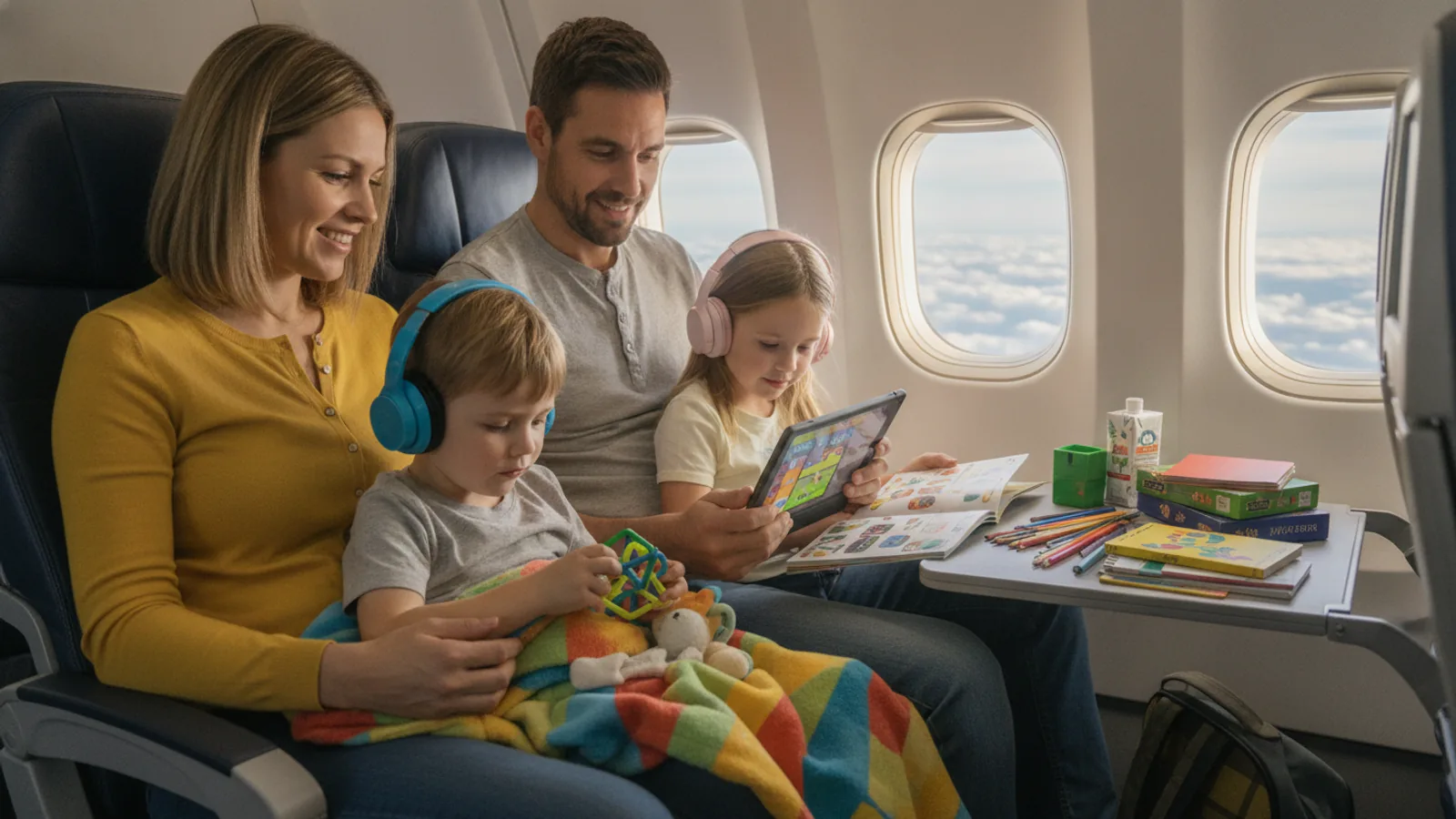
Before the flight, gather a small backpack or tote bag dedicated to your child's entertainment. Fill it with a mix of activities that are quiet, compact, and mess-free: coloring books with washable markers, sticker books, a few small action figures or dolls, a travel-sized board game, and a deck of cards. Avoid items with many small pieces that could easily be lost. Wrap each surprise in tissue paper so that unwrapping becomes part of the fun. This step is crucial because the element of novelty captures your child's attention and makes the activity feel like a treat, not a routine. Present the bag only after the plane reaches cruising altitude, and ration the items: one surprise per hour of flight. Check the bag's weight and contents to ensure you have enough to cover the longest leg of the flight without extras.
Create a Flight Entertainment Schedule
Write out a loose schedule for the flight, breaking it into segments such as 'after takeoff,' 'mid-flight,' and 'before landing.' Allocate activities for each segment: a movie or show for the first hour, a snack break with a storybook, a quiet coloring session, a game of I-Spy, and then a walk to the lavatory. Build in buffer time for unexpected delays or long meal service. Having a schedule gives you a sense of control and prevents both you and your child from feeling overwhelmed by a never-ending flight. It also ensures that the most engaging activities are spread out and that screen time is limited, promoting a healthier mix of rest and play. Check your plan to confirm you have enough activities for each segment, adjusting as needed based on your child's age and attention span.
Introduce Quiet Games and Storytelling
Engage your child with interactive quiet games that require no props, such as 'I Spy,' '20 Questions,' or a storytelling game where you take turns adding one sentence to a story. These games are excellent because they adapt to any age and can be played in a cramped airplane seat. Start with a game like 'I Spy' using only colors or objects in your immediate view, and gradually increase complexity. For storytelling, begin with a familiar scenario like 'Once upon a time, a little dragon flew over the clouds...' and let your child invent the next part. This activity stretches their imagination and keeps them focused. Check that your child is engaged and not too loud; if they get bored, switch to another game or introduce a snack. The beauty of these games is that they require no setup, so you can play them at any moment, turning potential meltdown moments into fun.
Plan for Snack and Hydration Breaks
Pack a variety of small, mess-free snacks like cereal, pretzels, fruit pouches, and cheese sticks, and offer them at regular intervals. Avoid sticky, crumbly, or strongly scented treats that could be disruptive. Hydration is equally important, as dry cabin air can cause fatigue and irritability, so have a sippy cup or water bottle with a straw to reduce spills. Aim to offer a snack every two hours, but watch your child's mood: if they're starting to get cranky, a snack may help. Before giving a snack, check that your child is seated and wearing their seatbelt if required. This routine helps regulate blood sugar, prevents hunger-induced sulks, and gives your child something to look forward to. Remember to pack extra snacks than you think you need, as flight delays can extend the journey.
Incorporate Physical Movement Safely
Encourage your child to stretch and move safely in the cabin. After the seatbelt sign is off, take short walks up and down the aisle, visit the lavatory to wash hands, or do simple seated stretches like rolling shoulders, touching toes, and wiggling fingers. For young children, have them 'gallop' in place or do a gentle 'airplane yoga' sequence. Movement is vital because it helps prevent restlessness, poor circulation, and muscle cramps during a long sedentary period. Check that the cabin is calm and that the seatbelt sign is off before moving; always hold your child's hand in the aisle. These micro-activity breaks also give your child a chance to reset their attention span, making it easier for them to settle back into a quiet activity afterwards. Plan to move every 90 minutes to two hours.
Manage Screens and Headphones
If you choose to use screens, set them up for success by bringing a pair of child-sized headphones that are comfortable and not too loud. Before the flight, pre-load a couple of movies or shows that your child loves, and also download a few educational games that work without internet. Set a timer for screen time, such as 30 to 45 minutes at a stretch, and enforce a break afterwards. When using a tablet or phone, prop it securely on a tray table using a stand or a thick book, and position it so your child doesn't have to strain their neck. Check that the volume is not too high to avoid disturbing others and to protect your child's hearing. Explain to your child that screen time is a treat, not a constant, and that they will need to pause for snacks and stretches. This approach prevents overtired, overstimulated kids.
Quick Reference
| Situation | Action | Why it helps |
|---|---|---|
| Your child starts crying loudly during landing descent. | Offer them a lollipop or a drinking bottle to swallow, and calmly talk in a low, soothing voice about what they see out the window. | Sucking helps equalize ear pressure, which reduces pain and crying, while distraction with a window view shifts focus. |
| Your child refuses to wear their seatbelt during turbulence. | Firmly but kindly say, 'Seatbelt on is the rule,' and show them how to buckle it yourself, then praise them for following the rule. | Clear, consistent enforcement is necessary for safety, and positive reinforcement encourages future compliance. |
| Your child gets bored with the same activity in the first hour. | Quickly switch to one of the surprise wrapped activities from your bag, creating excitement and renewing interest. | Novelty boosts engagement, and a small new object acts as a powerful incentive to calm down and focus. |
Common Issues
- The child spills a drink, making a mess.: Keep a small pack of wet wipes and a spare t-shirt in your carry-on. Immediately blot the spill, change the child's clothes if needed, and use a napkin to soak up the liquid. Reassure the child it's okay and move on calmly.
- The child is too restless and keeps kicking the seat in front.: Gently remind them, 'Kicking can hurt the person ahead,' then offer an alternative like a foot rest or a soft toy. Take a walk up the aisle, and play a quiet game like 'I Spy' to redirect their energy.
- The child feels anxious during takeoff or turbulence.: Hold their hand, explain the sensations simply ('The plane is just gaining speed'), and do breathing exercises together. Count breaths slowly and focus on a happy memory or a planned activity after landing.
Advanced Tips
- Create a personalized 'flight book' with photos of the plane, the seats, and your family, along with a social story that describes each phase of the flight in simple words, to help toddlers anticipate what happens next.
- Use noise-cancelling headphones to reduce the drone of the cabin environment, which can overstimulate sensitive children and make it hard for them to sleep or concentrate.
- Pack a small, shatterproof mirror and show your child how light reflects off it to play a 'sunbeam game' on the cabin ceiling (but avoid shining it in others' eyes).
Final Checklist
- Have you packed a variety of activities, including at least one surprise wrapped item, and checked that they are mess-free?
- Did you pre-load a few movies and games on a device, and test that they work offline and with headphones?
- Are your snacks and drinks within the allowed quantity and placed in a quick-access pocket?
- Have you reviewed the airline's rules on carry-on items and safety with your child, and explained the seatbelt and behavior expectations?
FAQ
What if my child sleeps through most of the flight?
That's often a win, but ensure they don't miss out on hydration and movement. Gently wake them for snacks and a walk every few hours, even if they're groggy. This helps prevent deep vein thrombosis and makes the transition back to regular time easier. Also, keep their favorite comfort item nearby to ease them back to sleep.
How can I keep my child entertained without any screens?
Plan a rotation of traditional activities: sticker books, magnadoodle, puzzle books, mini playdough, and interactive games like 'I Spy' or '20 Questions.' Also, bring a few small dolls or action figures to act out stories. Set a routine where you play a game together for 10-15 minutes, then let them play independently for a while.
My child refuses to eat airplane food. What should I do?
Don't force it; instead, offer your own snacks that you know they like. You can also request special meals (like a child's meal) in advance, but be prepared that they may not eat it. Provide a variety of small, familiar foods and let them choose when to eat. Eating at non-standard times is fine, as long as they stay hydrated and don't get hungry to the point of becoming irritable.